Tag: reviews
-
Read: salt slow+
salt slow
This little book by Julia Armfield has a lot to offer. Nine short stories all with a shade of the Gothic or the macabre about them as they explore different comings, goings and phases in women’s lives. All are well-written, clever and engaging. These are stories that can make you ache with feeling.
There are romantic relationships – queer and straight – that are fraught with difficulties, pain and loss. There are sisterly relationships; both affirming and fractious. There is a hint of the monstrous in each story, which seems to make each one evermore human.
The missing star between 4 and 5 is simply because some of the stories didn’t hit 5/5 for me, personally, and you should definitely read salt slow for yourself as they may resonate with you perfectly.
4/5
To Sleep in a Sea of Stars (sneak peek)
This was the first ~300 pages of upcoming novel by Christopher Paolini (of Eragon fame) – not a long enough review to warrant its own post but definitely a title to keep an eye out for later this year!
This ‘sneak peek’ was excellent and I’m excited for the full book’s release this September. It is a brilliant start to a story I really want to keep reading and I’m now a little dismayed I have to wait another 3 and a half months to see where Kira is taken next. This feels like the beginning to an epic tale and I cannot wait to jump back in.
5/5
-
Read: The Nothing Man
The Nothing Man offers something a bit different to the serial killer, cat-and-mouse thriller staple and two nights running I read up until midnight because I wanted to know what would happen. Initially, the book-in-a-book idea made me a little sceptical but I needn’t have been. We have two narrators; the first, of our book, is Jim Doyle, who we already know is the serial killer in question; the second, of the book he’s reading, is Eve Black, a woman who survived Jim’s most brutal attack as a child. Neither are 100% trustworthy, which adds some nice extra layers of mystery. Catherine Ryan Howard has done well to make Jim a really odious figure and – despite him being our primary narrator – we really want him to get caught.
Added bonus is this is not a thriller set in America, like so many are; it’s set in Ireland, in otherwise sleepy Co. Cork, and this gives the impact of the murders a little more punch because they truly stand out in the collective memories and because we know then that law enforcement was never prepared for such crimes.
Overall, this is a captivating read and well worth looking into for a bit of a different approach to storytelling in the thriller genre.
4/5
This was an Advanced Reader Copy, courtesy of NetGalley and the publishers, in exchange for honest review.
-
Read: Invisible Differences
With lovely art style and a story told with compassion, Invisible Differences is about a woman in her late 20’s being diagnosed with Asperger’s in a country that doesn’t give it much credence where misinformation is rife. While Marguerite’s story is centred around autism, this is a story that anyone with a form of neuro-divergence can recognise themselves in and find a bit of comfort in seeing Marguerite triumph.
It is also wonderful as an educational tool to explain what living with ASD (or generally being neuro-atypical, or having a chronic condition) is like in a way that isn’t condescending or light-footed. It’s perfect to evoke an empathy and understanding in others who may not have first hand experience of conditions like this. To those of us who have, Dachez leaves us a heartwarming note at the beginning of the book to remind us we shouldn’t hold ourselves to the standards of others and to live our lives without fear. Something we could all do with being reminded of now and then.
I see a lot of myself in Marguerite: sensitive to noise, drained by social interactions and the spoon theory as well as some of the negative interactions she goes through before officially receiving her diagnosis. The uplifting outcome is all the better for knowing this is a true story of the author and her artist friend.
This has been a translation from a French original and I didn’t detect any jilted phrases along the way so excellent in every respect.Invisible Differences: A Story of Asperger’s, Adulting, and Living a Life in Full Color With thanks to NetGalley and the publisher for offering an ARC (Advanced Readers Copy) in exchange for honest reviews.
Invisible Differences’ English edition is set to be published 18 August 2020 from Oni Press.
You can also see this review on GoodReads, here: https://www.goodreads.com/review/list/33265375-rai-fg
-

Read: Ghost Wall
 Ghost Wall by Sarah Moss
My rating: 2 of 5 stars
The Blurb
I found the blurb for this book, with hindsight, a little misleading. Similarly it’s classification in ‘Horror’ fiction and whatever algorithm suggested it to me having just finished a ghost story. If you find yourself thinking this is a ghost horror; it’s not. There are no ghosts nor any supernatural goings on. To me, expecting a ghost story I was a little disappointed – more on what’s actually in the book later.
The Prose
This is written in what I can only think to describe as continuous prose. There are no speech marks and no new lines for dialogue. There’s internal and vocalised dialogue mixed in together that is hard to differentiate. It is one long train of thought from the narrator, Sylvie, and it does get hard to follow. I was OK dealing with it around 70% of the time and the remainder I found myself puzzling, re-reading and ultimately being jarred out of the flow of the story. This meant I couldn’t fully engage with the story because of both content and style.
The Story
*THIS SECTION CONTAINS SPOILERS*As I mentioned before, there’s no ghosts. I kept reading in the hope that some would appear once the eponymous Ghost Wall was constructed by the characters. Still, no. Instead the story is one of domestic abuse and violence enacted by Sylvie’s Dad on both her and her mother. The setting of an experiential archaeology field trip is superfluous to the central story of the abuse and the story could have been set anywhere. I found a lot of it an unpleasant read – with a knot in my stomach and a desperate desire to jump into the story and talk some sense into everyone involved. I was frustrated and angry.
That is the greatest success of this book: that it makes you feel angry and awkward and impotent at the plight of two women being physically and psychologically abused. It is also for this reason I find it a little disrespectful to classify the book as ‘horror’. Not to the author, or the book, but to the real people in real life who have to suffer like Sylvie and her mum. Those situations are horrifying and they are real. I know it’s unlikely the exact events of Ghost Wall have happened in real life but many similar things have – and they are not ‘horror’ fiction.
Overall
It is a realistic account of domestic abuse and especially how it can mess with the victim’s mind. If you weren’t expecting that, then be aware this won’t be a pleasant read. The style of the prose is hard to stick with and you may get lost along the way. The story ends just as Sylvie might be getting a chance at something better – and I want to read about that – which was a little frustrating as well. The blurb and classification of the book are a bit off; do a bit more research than I did and read through other people’s reviews – don’t just look at the average rating.
The combined issues I’ve highlighted, for me, detracted from the overall experience. I would still say it was an important read even if I didn’t like it much in the end. It is certainly not an easy read.
View all my reviews -
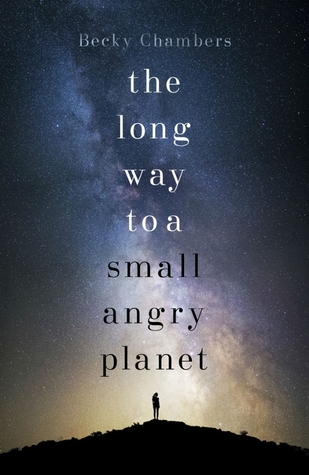
Read: The Long Way to a Small, Angry Planet
Spoiler: it’s not Earth.
Taken from GoodReads
 The Long Way to a Small, Angry Planet by Becky Chambers
My rating: 5 of 5 stars
Surprisingly this came as a recommendation from my mother who is very rarely into SF and she gave me her copy to read after she was done. It took me a while to feel ‘in the mood’ for SF and I eventually picked it up earlier this year (2019) and I absolutely adored it.
It made me think, it made me tear-up, it made me smile, it made me tense and I love the character-driven nature of it all. This is not your average ‘jump in the spaceship and go to war’ sort of SF and it is all the better for it. This is a story about people and it happens to be in space. Gorgeous, interesting people with actual relationships that I really invested in.
I found the inclusion of gender-variance and the exploration of self-hood very natural and not shoe-horned at all. The depiction of the different races’ values and customs was well done and highlights where so much other SF is lacking. Chambers seems to have a mind much like my own in realising SF shouldn’t be so human-centric. We shouldn’t assume alien races would even want to know us let alone change their entire culture to accommodate us should we ever reach the stars.
It doesn’t hurt that the cover art for all three of the series is very tasty and I ordered A Closed and Common Orbit immediately after finishing this one and I cannot wait to get started. Even if you are not a sci-fi person normally (like my mum), this is still well worth your time. It is an enlightening, inspirational and genuine pleasure to read.
View all my GoodReads reviews -

Going Out: The Botanist
My birthday falls in one of those awkward times of year: in the holidays. More specifically, over the Christmas holidays, smack bang between Christmas and New Year. Owing to this, it’s often quite difficult to celebrate with others on my actual birthday so, some years, I’ll do something a couple of weeks later in January to give people a chance to come along.
This year for my delayed birthday celebrations we headed to The Botanist on Temple Street in Birmingham city centre. Temple Street itself boasts a whole host of eateries and bars so can always be relied upon for the buzz of revelry. The Botanist is a quirky looking venue with a veranda at the front and metal gates that wouldn’t look out of place at an RHS show garden. It is possible to book tables online up to 6 people, any more and you’ll need to ring up. I will say that booking in advance is essential, especially for a Friday or Saturday.
We rocked up on a Saturday (12 Jan) for a 6:30pm sitting and were told by the bouncers at the entrance that we’d have to book if we wanted food – “we already have!” – as we wandered in. You can’t see the restaurant seating from the street and it’s revealed as you meander through and past the bar area. There’s surprisingly more space than it seems from outside, and still quite limited if you count the numbers.
The staff were all friendly and helpful, if a little slow towards the end. A little unfortunately we were sat next to an over-crowded table, also celebrating a birthday, at a much higher octane.
Having pre-examined the menu and gone for a lighter lunch, starters were in order. I had the Cumberland Chipolatas with honey and sesame, which came off the “Small Plates” section of the menu. They were very tasty, if a bit sticky and the sweetness got a bit much by the end. There was quite a good portion included and I suspect they are more targeted at being a one-of-many tapas style plate to share. Nevertheless, well cooked and presented and quite scrummy.
For mains I had the chicken option of their “Famous Hanging Kebabs” with some regular fries. The presentation of these kebabs is the most striking element of the food, with a skewer hanging vertically over your chips. They do provide an empty plate onto which to decant your side and meat/kebab to make tackling it a bit easier. Again the food was well cooked and tasty; my dish came with a sweet chili dip that at the time I couldn’t tell what it was as it flavour wasn’t particularly strong.
Finally, between four of us, we ordered “The Botanist Allotment” to share. This comes on a large platter with a variety of mini desserts to choose from with the added spectacle of some dry ice spilling out from a little planter in the middle. It is definitely great fun. There were two of each dessert on the platter although after a full meal this was the perfect amount between us.
All in all the food may not look like there’s a lot there yet we were all satisfyingly full by the end of it. There is a lot of spectacle involved here but it isn’t overdone at the expense of the food quality. The decor is interesting and themed, although when watching some of the waiting staff ducking under some of the decorations it could look a bit crowded.
On the topic of refreshments, this is a gin-centric location but don’t worry, they have plenty on offer for everyone. I don’t consider myself a ‘gin person’ yet thoroughly enjoyed the “Poppy and Pomegranate Martini” even though I half expected to hate it while ordering. It was a chance and it paid off. I would definitely recommend The Botanist to anyone looking for some nice food in the city that’s a little more than burgers (which Brum has a lot of) that isn’t too stuffy.
5/5
-

Read: The Book at the End of the Year
The Cabin at the End of the World by Paul Tremblay: A Review
As my first completed book of 2019, I freely admit I started it at the end of 2018 (back on 28 Dec) as a group I’m in on Goodreads is having a discussion about it over January with the author. I read this over the course of a week, although if taken without any breaks it was more like 3 days, and surprised myself how quickly I got through it. I was reading the Kindle version having grabbed it fairly cheap over Christmas.
It doesn’t have traditional chapters, which confuses the Kindle reader, moreover it has larger sections broken down into smaller parts that are entitled with the character who’s viewpoint the passage is in. I’m not a fan of labelling the point of view and prefer to figure it out simply from the text itself however in this case it became useful towards the end of the novel when the action ramps up.
The story follows an ordeal that besets Wen and her two fathers, Andrew and Eric, when a group of strangers appear at their remote holiday cabin asking for their help to halt the apocalypse. Violence is inevitable from the moment the sinister Leonard starts asking Wen odd questions in the front yard as she catches grasshoppers and the likelihood escalates as three more strangers appear and Wen runs in to her dads to tell them.
After forceably entering the cabin and restraining Andrew and Eric, Leonard et al tell their tale of visions and instructions that lead them all to this “special family” in the cabin with the red door and that, without them, the world will shortly end. Without spoiling any further goings on, what faces the group is a desperate struggle to grapple with damning information and inexplicable actions.
While an entertaining read, I wouldn’t describe this as ‘horror’ as many others have. It isn’t scary or particularly disturbing; similar to ‘Head Full of Ghosts’, the book looks at what is a variation on events that have almost undoubtedly happened somewhere at some time in modern history. If you find it disturbing that humans can do terrible things to each other then you may want to consider if you are too naive for Tremblay’s work.
Across both ‘Head Full of Ghosts’ and ‘The Cabin at the End of the World’, Tremblay’s prose paints a dim view of organised religion and the part it has to play in the atrocious things people do to one another. While it’s primarily focused on Christianity or adjacent faiths, the impression remains that it extends to all organised monotheist religions prevalent in the world today. Whether this is a reflection of the author or simply an easy thread to pull on to add an extra dimension to his stories, I couldn’t say.
Overall the prose is well written, with the exception of the let’s-hyphenate-a-bunch-of-words-together tendency that crops up a few times throughout the book. If you’ve read ‘Head Full of Ghosts’, you may remember the last minute almost twist at the end and ‘The Cabin…’ has a similar mechanism in the last pages. It made me consider the similarities in composition between the two books and, while they tell two different tales, there are a fair few.
In terms of rating, I find myself perhaps a little too cynical for Tremblay’s books as none of the content surprises or disturbs me as the genre classifications suggests they should. It has made me wonder if the author wrote these intending to disturb or intending merely to shine a light and point out the horrible things that occur in everyday society. While I’d definitely consider reading more of his work, I shan’t expect to be scared by it.
3.5/5
This review is also on Goodreads: here.

